On an incredible night at Emirates Stadium, Arsenal overcame Bayern
Munich 2-0, recharging the Gunners’ UEFA Champions League campaign with a
victory over the team anointed best in the world.
A scrappy
set-piece goal by substitute Olivier Giroud and a stoppage-time clincher
by Mesut Özil, assisted by the irrepressible Hector Bellerin, undid
Bayern and made imaginable another qualification for the competition’s
knockout phase. That prospect seemed remote prior to Tuesday.
Calming
down enough to analyze a such an emotional match takes effort, but here
are three things we think we learned from the encounter.
This Arsenal team can produce the memories
Supporters
follow sport for scenarios like this: Arsenal faced a mighty opponent
in a headline affair, performed solidly but without much of its
trademark creativity for much of the match, then struck when the
opportunities arose.
This is what so many of us look for on
European nights, recognizing that the Gunners may not win the
competition in the end but hoping for transcendent performances to
remember. The turnaround of fortunes—the likes of which Arsenal have
certainly experienced from the other side—made the magic all the more
memorable.
If you can’t take a few days to enjoy that, well, you need a different pastime.
It
was a different plotline from the other indelible memory of the season
so far, the 3-0 dismantling of Manchester United. Unlike in that
contest, Arsenal did not carry the play against Bayern. The quality of
the passing, the quickness of thought and movement, the incomparable
skill were not what won the day.
Instead, the Gunners were
unified, determined, organized but flexible, and opportunistic. They
seized the game's three decisive moments—Petr Cech’s save on the
heretofore unstoppable Robert Lewandowski, Giroud’s headlong commitment
in case Bayern suffered a defensive lapse, and Bellerin’s late steal,
surge, and perfect pass to Özil. In the process, they generated
happiness among supporters, confidence for themselves, and respect from
opponents and neutrals.
No matter what happens in Munich or
Athens, where qualification will likely be decided, we’ll always have
the Emirates on 20 October.
This Arsenal defense is a match-winner
Tuesday's success required a comprehensive defensive performance. And that's what Arsenal delivered.
The
Gunners controlled the dangerous spaces throughout the match and
rendered sterile Bayern's advantage in possession. As a result,
Arsenal's defensive statistics were not particularly impressive: 24
tackles, 19 interceptions, 18 clearances. (Numbers from Opta via
FourFourTwo's StatsZone app)
But eight blocked shots were evidence
of Arsenal's commitment and contributed to Bayern's laboring to get a
clear sight of goal. The Bavarian side enjoyed just two "Big Chances,"
in the parlance of the StatsZone app, Lewandowski's effort midway
through the second half and Thiago's pointblank shot early on. Cech was
equal to the task both times.
Meanwhile, despite making just one pass for every three made by Bayern, Arsenal created four big chances and scored two of them.
Bayern
looked dangerous many times, particularly left winger Douglas Costa in
the first half. But when Costa escaped Bellerin, an Arsenal player was
there to intercept the pass or snuff out the dribble.
On Arsenal's
left, Bayern tried various approaches and personnel against Nacho
Monreal. None succeeded. Thomas Müller, the lethal forward, got so
little out of his battle with Monreal that he surrendered his spot on
the right to Arturo Vidal, whom Monreal controlled as well. Efforts to
outnumber the Gunners on that flank similarly came to nothing.
In
the center, Per Mertesacker controlled the airways and Laurent Koscielny
made several critical interventions as Lewandowski threatened. Just
ahead of them, Francis Coquelin and Santi Cazorla attended to the
dangers in Bayern's buildup play.
Those attentions did not always
prove adequate, but Cech was an impregnable last line of defense,
stopping all six shots Bayern put on goal.
Arsène Wenger pulled all the right levers
The
Arsenal manager sent out his charges with clear directions: Control the
space, not the ball. Try to frustrate Bayern. Then hit on the
counterattack.
When the initial formation, with Alexis on the left
and Özil farther forward, showed some vulnerabilities, the setup
shifted. Alexis moved upfield closer to Theo Walcott, Özil retreated to
work with Monreal on the left, and Arsenal took on a deep-lying 4-4-2
shape.
As Wenger explained,
"When we were playing halfway, they opened us up too much, so I decided
to drop Ozil a bit deeper and to make it tight around the box and catch
them on the break because we have the pace to do it and to find some
space with the game going on."
This freed Alexis, Arsenal's danger
man, from the challenging defensive situation on Arsenal's left, where
Müller, Thiago, and right back Philipp Lahm tried without success to
overwhelm Monreal, and allowed the Chilean to pose an additional threat
to Bayern's high defensive line.
Worn down by Arsenal's speed,
perhaps, Bayern's central defenders had difficulty coping with the
physical presence of Giroud when he replaced Walcott in the 74th minute.
Three minutes later, Giroud drew a foul, fought his way through the
defensive line, and capitalized when goalkeeper Manuel Neuer failed to
claim Cazorla's free kick.
Extra time
Giroud
is a game-changer. He delivered his fourth goal in his last six
substitute appearances. He could have had another later but wasn't able
to generate the necessary power to his free header. The Frenchman was
also an outlet for Arsenal's back line for the 17 minutes in the lead
and shored up Arsenal's set-piece defending during the final stretch of
this famous victory.
Here’s the thing about sport in the Internet 3.0 age: It both fulfills and warps our need for drama.
Because
the desire for a narrative to provide excitement and emotional succor
is limitless, and the means to sate that desire always available, we
raise otherwise tedious affairs to an undue level of importance. The
Arsenal Annual General Meeting is a perfect example—who really thought
that gathering would reveal anything of substance about the club?
Of
course the presentations from the homogeneous board and executives were
pro forma. Of course manager Arsène Wenger was the star of the show. Of
course interrogators did their self-important best to put themselves at
the center of this manufactured drama.
Fortunately, the slog
through that story lasted less than a day. Now we can return to the
reason to follow sport, the actual competition: Arsenal make the short
yet unfamiliar trip to Vicarage Road to face Watford on Saturday.
The
prospects in general and in particular are encouraging. The Gunners
emerged from a challenging three-game stretch in a improved league
position. Stirring and convincing wins over Leicester City and
Manchester United, the fourth- and first-place teams in the league
before their losses to Arsenal, have lifted the Gunners to second place.
And
performances against Watford-like opponents have pushed Arsenal to top
league finishes in recent years. In 2014-15, the Gunners racked up 54 of
60 possible points against the bottom half of the Premier League, only
dropping points in draws with Everton, Leicester City, and Hull City.
The total from the previous season was 53 of 60, marred by the
opening-day loss to Aston Villa.
The outcome of any sporting endeavor is not inevitable, however. That’s the source of the drama.
This
matchup with Watford has several elements of a trap. It’s an away game
right after an international break against a team whose players did not
labor intensely, if at all, for their national teams. Just four Hornets,
Austrian Sebastian Prödl, Ecuador’s Juan-Carlos Paredes, the Greek José
Holebas, and Odion Ighalo of Nigeria, played for their senior national
teams during the most recent break.
More Arsenal players (seven)
scored during international matches than that, while a total of 11
Gunners were away on senior international duty.
In addition,
Watford is a physical and effective defensive side, ranking in the
league’s top five for fouls and interceptions. The Hornets have allowed
just one goal at home, in a 1-0 loss to Crystal Palace, and held the
potent offenses of Southampton and Swansea scoreless there.
That
approach will test Arsenal’s collective concentration and patience. Will
the Gunners be able to fire right from the start, as they did against
Manchester United? As is often the case in the Premier League, an early
goal would be a boon. It would force Watford to adjust its defense-first
plan and open space for the speed and skill of Arsenal’s attacking
players to thrive.
But this team has shown that it can grind out
the results, particularly on the road, as well. The wins at Newcastle
and Crystal Palace, achieved when the Gunners were struggling to score
goals, might be experiences that they can draw on this weekend. Then
again, now that Alexis and Theo Walcott are firing more effectively, the
pattern might be less labored on Saturday.
Regardless of the
method, a win is crucial for Arsenal’s title aspirations. It would
represent a positive kickoff to the upcoming series of eight winnable
Premier League matches, it would bank three points, and it would keep
the story where it belongs—on the team’s on-field success.
Players to Watch
Arsenal. Theo Walcott. It
was tough to take your eyes off the new Arsenal front man against
Manchester United. He pulled the defense around without mercy, harried
them when they had the ball, and twice set up teammates for goals. A
similar performance away from home against less-headlining opposition
would strengthen his center forward bona fides.
Watford. Odion Igalho. Watford
has scored just six goals in eight league matches, and Igalho has five
of those. His combination with Troy Deeney has produced three goals and
makes them one of the top provider-goalscorer combinations in the
league.
While we marvel in the sublime skill and breathtaking speed Arsenal
displayed against Manchester United on Sunday, we should also praise the
team’s tactical triumph. The flexibility that manager Arsène Wenger and
his players displayed bamboozled the visitors and their supposed
tactical genius of a manager, Louis van Gaal.
In fact, van Gaal’s
approach played right into Arsenal’s hands, permitting the Gunners to
emphasize their strengths and to exploit Manchester United’s weaknesses.
Once Arsenal had secured the three-goal advantage, they adapted to
various situations and remained the superior force.
Let’s look at how the game plans unfolded.
Early onslaught
Arsenal
showed every intention of starting the match assertively. This not only
represented a response to the poor midweek showing in the Champions
League against Olympiacos, but it also conformed to the patterns of this
Premier League season. In particular, the home team takes the
initiative early to gain the superiority it needs to play on the
counterattack. (See Danny Higginbotham’s column in The Independent for a clear explanation of this trend.)
Two
goals before the 10-minute mark are the proof Arsenal succeeded. Here’s
evidence of the intention: Deep-lying midfielder Francis Coquelin’s
position just before Alexis Sanchez opened the scoring.
Coquelin
helps start the attack, then follows Hector Bellerin and Mesut Özil up
the right side of the pitch into an advanced position for a defensive
midfielder. From where he is, he can trouble three of United’s possible
escape routes, via Wayne Rooney, Bastian Schweinsteiger, or Memphis
Depay.

- Coquelin joins attack but positions himself to thwart any possible United counter-attack
As
it happens, Manchester United does intercept Bellerin’s centering pass,
but Coquelin beats Memphis to the ball and gets it back to Özil. That’s
when Özil’s quick interchange with Aaron Ramsey and sprint to the
byline scramble the Manchester defense and create the scoring
opportunity.
Manchester United’s susceptibility
The buildup to this play also reveals Manchester United’s vulnerability and the flaws of its game plan.
Van
Gaal apparently decided to man-mark Arsenal in the center of the pitch.
Schweinsteiger covered Santi Cazorla, Rooney was assigned Coquelin, and
Michael Carrick was on Özil.
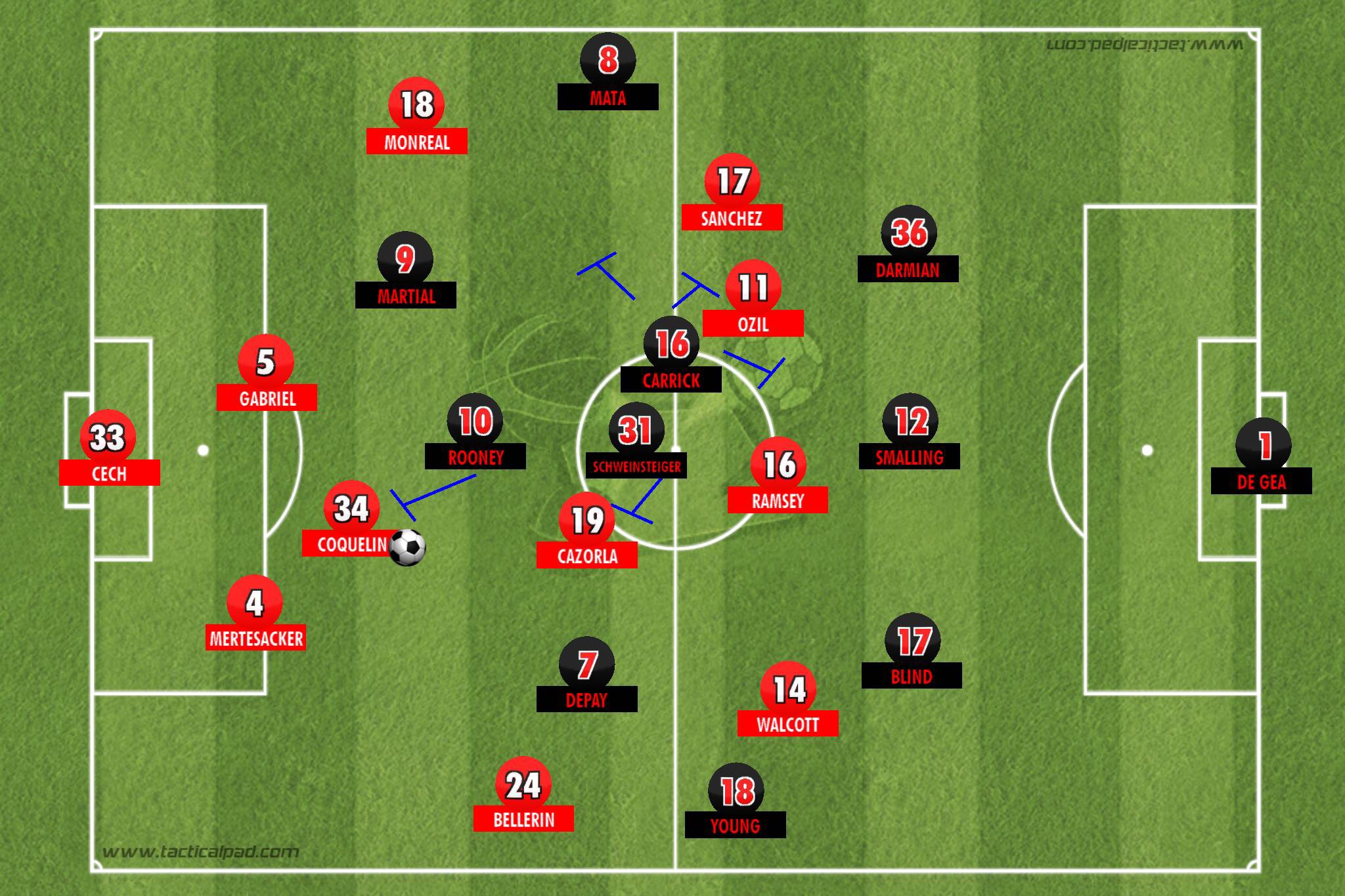
- United's man marking the midfield put them at a distinct disadvantage in controlling the match
This
setup handed the initiative to Arsenal. Schweinsteiger is 31 years old;
Cazorla is only a year younger but a magician with the ball. Rooney is
29; Coquelin, 24. Carrick is 34; Ozil, 26. Add the speed of thought and
passing to the age difference, and Arsenal were just too quick in the
midfield.
A word here, too, about the role of Per Mertesacker.
Schweinsteiger leaves Cazorla and tries to close down the Arsenal
captain, but Mertesacker outfoxes him with a one-touch pass to Coquelin,
who has eluded Rooney. This springs the attack.
Flailing fullbacks
Another
consequence of Manchester United’s man-marking in the midfield was that
its fullbacks had very little support defending the spaces on the
flanks. Alexis took advantage of this situation, running Matteo Darmian
ragged.
The situation titled even more favorably toward Arsenal
because Manchester United central defenders Chris Smalling and, in
particular, Daley Blind were sensitive to the threat of Theo Walcott.
Walcott’s speed and movement upset the defensive balance and, just
before the third Arsenal goal, forced Darmian into a narrow position,
leaving Alexis free to receive Walcott’s pass and move into a
threatening position with the ball. (See Adrian Clark's analysis of this
passage of play on The Breakdown on the official Arsenal website.)
With
Ashley Young defending like a winger playing fullback on Manchester
United's left, the effectiveness of Arsenal’s Bellerin and Nacho Monreal
was a stark contrast.
Consolidation
Immediately
after Alexis drove home his second goal of the first 20 minutes,
Arsenal’s objective changed. A three-goal lead made controlling
dangerous spaces the priority. Manchester United’s ponderous play helped
Arsenal in this respect, as did the shift to a 4-4-1-1 formation.
Coquelin
and Cazorla moved together closer to the center of the pitch and
Arsenal’s center backs, while Alexis and Ramsey dropped deeper from
their attacking initial positions.

- Arsenal move to a 4-4-1-1 to protect the lead
Alexis
is slightly advanced here because he’s engaging Darmian on Arsenal’s
left, but overall this is the compact shape Arsenal used to protect its
lead and start further counterattacks.
It’s a perfect response to
the game situation, Arsenal having earned the right to play on the
counter with its early three-goal blitz.
Adaptation
At
halftime, Van Gaal replaced Darmian with Antonio Valencia and Memphis
with Marouane Fellaini. The latter brought his
physical-bordering-on-fouly presence into the center of midfield. This
change spurred the visitors to become more assertive in midfield,
creating two shots on target midway through the half.
Wenger and
his team adapted. He instructed Ramsey to leave his post on the right
and join Coquelin and Cazorla in the center of midfield. Özil went
right, and Arsenal took a 4-3-3 shape.

- Ramsey tucks in to form a 4-3-3 to adjust to United's halftime changes
This adjustment largely succeeded in upsetting Manchester United’s rhythm.
Later,
Wenger made one final shift, introducing the more physical center
forward presence of Olivier Giroud and returning to the 4-2-3-1 shape
from which Arsenal had started the match. Only this time, Ramsey took
the playmaker role and joined Giroud in defending from the front of the
formation. Substitute Alex Oxlade-Chamberlain became the main threat on
the counterattack, nearly capping the scoring with a chip off the bar in
injury time.
Had that gone in, the final score of 4-0 would not
have flattered Arsenal. With a clear game plan, tactical flexibility,
expert execution, a focused mentality, and physical commitment, the
Gunners dispatched one of its bogey teams and made manifest their
potential to mount a title challenge.
(Graphics courtesy YouAreMyArsenal)
Arsenal produced a swashbuckling 5-2 win at Leicester City on Saturday.
The
performance doubled the Gunners' goal output for the season and ended
Leicester's unbeaten opening run. Combined with the midweek win over
Tottenham in the Capital One Cup, Saturday's victory represented a
strong response to disappointing losses in the two preceding contests at
Dinamo Zagreb and Chelsea.
Here are three things we learned from the match.
Don't get into a shootout with Arsenal
In
truth, we could fill a report with accounts and analysis of the various
ways Arsenal scored--incisive counterattack, deft crosses, individual
skill off a set play, precise timing of a fullback run. That's testament
to how rampant Arsenal's offense was in this match.
Allowed space
by Leicester's high defensive line, Arsenal's Theo Walcott and Alexis
Sanchez swooped into dangerous areas again and again. Leicester's
midfield failed to put pressure on Santi Cazorla and Mesut Özil, giving
those two pass masters many opportunities to pick out the runs of their
teammates farther forward.
The numbers (from Opta via the StatsZone app) reveal the consequences.
Arsenal
had 26 shots, an amazing 22 inside the Leicester penalty area, and only
missed the target with one (not including the 14 blocks Leicester
made).
Cazorla completed 71 of 77 passes (92 percent), created
five opportunities for teammates, and assisted on Walcott's opening
goal. Özil connected on 54 of 59 passes (also 92 percent), also created
five scoring chances for teammates, and delivered a delicious cross for
Alexis's second goal.
Leicester tried but could not match the
Gunners' effectiveness in attack. The Foxes took 16 shots of their own,
11 in the Arsenal penalty area, and opened the scoring in the 13th
minute when Jamie Vardy latched on to a long clearance, outran Per
Mertesacker, and finished past Petr Cech into the far corner.
This set the tone for a wide-open match, which played to Arsenal's strengths.
Alexis loves Leicester
The King Power Stadium in Leicester will hold fond memories for Alexis when he ends his time in the Premier League.
Arsenal's
star man got his first league goal there last season and ended his
early season drought there Saturday with goals of opportunism and top
quality.
His first was a welcome, straightforward finish, thanks
to Walcott's clever run to the near post, which took two Leicester
defenders with him. When Hector Bellerin's cross was redirected by that
three-player melee, Alexis found himself with the ball in front of an
open goal. The easiest of putaways got him off the mark for the season.
For
his second, he received another pass from the marauding Bellerin,
passed to Özil across the top of the Leicester penalty area, timed his
run to escape all the defenders, then redirected Özil's cross past the
onrushing Leicester keeper Kasper Schmeichel.
He capped the hat
trick with a screaming low shot from outside the penalty area, an
opening he generated himself with a deft flick of Nacho Monreal's
throw-in past Leicester's Ngolo Kanté.
These were a worthy payoff
for Alexis's combination of creativity, desire, and skill that took him
to such heights in his inaugural Premier League campaign.
Nacho Monreal may be the best left back in the Premier League
It's
a variation of the rags-to-riches story. Monreal joins Arsenal in
January 2013, primarily due to the injury of starting left back Kieran
Gibbs. The Spaniard does not thrive under the circumstances but
gradually learns the requirements and tricks of a Premier League
defender.
Watch the recent interview on the club's website for Monreal's thoughtful reflection on his career.
He's
now made 94 appearances for Arsenal; his latest was an absolutely top
performance against the league's in-form attacking player, Leicester's
Riyad Mahrez.
Mahrez came into the match with five goals and three
assists in six games this season. Monreal shut him out on Saturday, so
much so that Mahrez switched sides to try to find better opportunities
on Arsenal's right.
Overall, Monreal made seven ball recoveries,
succeeded on seven of the eight clearances he attempted, and won seven
of eight aerial duels. He also assisted on Olivier Giroud's goal in
second half injury time, taking advantage of the flagging Leicester
defense to reach the by-line and cut the ball back for the Arsenal
striker.
That closed Monreal's outstanding display and solidified
his place as the top left back in the league at the moment. Name a
better one.
Extra time
This was Walcott's top showing as a center forward for Arsenal.
The
conditions favored him: Leicester's lumbering center backs and
assertive defensive line gave him the space to use his speed. He did
that, connected with Cazorla's defense-splitting pass, and delivered a
subtle left-footed finish for Arsenal's first goal.
On other
occasions, Walcott created space for teammates with intelligent runs,
such as the one that freed Alexis for his opening goal. And he held his
own in the physical battles.
Mathieu Flamini’s stunning 78th-minute strike proved the difference as Arsenal eliminated Tottenham from the Capital One Cup, 2-1.
Although
Flamini’s volley was a rare moment of quality in this match, the two
sides put on an intriguing and spirited show. There were personnel and
tactical tweaks, hearty challenges, and a few nervous moments for
Arsenal’s defenders.
Here are three points that stood out.
Mathieu Flamini does a wicked Aaron Ramsey impression
We
don’t know if Flamini can deliver mundane lines with a slight Welsh
lilt, and it’s almost certain he can’t reproduce Ramsey’s level of
performance on a regular basis, but for this one night at White Hart
Lane, Flamini looked every bit the all-energy, goal-scoring midfielder.
Arsenal’s first goal owed to Flamini’s effort to follow up on Alex Oxlade-Chamberlain’s shot. In the 26th
minute, Flamini takes off into the Tottenham area just as
Oxlade-Chamberlain lets the ball run across himself and turns. Flamini
continues his run where Tottenham’s central defenders don’t follow,
pounces on the rebound, and lifts a lovely poacher’s finish over
Tottenham keeper Michel Vorm.
That’s the kind of energy and
product Ramsey has produced when he’s in form, from a similar position
in Arsenal’s central midfield.
As Flamini explained,
"I tried to be a bit creative today. I had the opportunity. I felt
there was maybe a possibility, so I went forward [for the first goal],
and the ball came back to my feet."
Flamini’s game-winner was
opportunistic in a different way. He has a lash at a poor clearance on
the edge of the Tottenham area and drives it into Vorm’s net. The same
intent—albeit with a lower degree of difficulty and less spectacular
execution—that Ramsey delivered on with his eye-catching Champions
League goal against Galatasaray last season.
During the rest of
the match, Flamini harried Tottenham, occasionally as the team’s most
forward presser as Ramsey often does, and dropped beside Mikel Arteta
when Tottenham advanced.
This range of activity meant that Arteta
and Flamini did not clog the midfield as much as we might have expected
the duo to do; instead, Flamini produced an attacking threat and end
product that Arsenal’s central midfield has struggled to create so far
this season.
Arsène Wenger agrees with Jack Wilshere
The
Arsenal manager made 10 changes to the side that played at Chelsea on
Saturday, leaving only Ramsey, who reprised his national team role as a
free playmaker. This despite Wenger’s comments before the match intimating he’d resist wholesale rotation:
It
is an opportunity for Arsenal to win an important game and for the
players who play for our club to defend our club and qualify. Apart from
that, we played with the team in Zagreb, and we didn’t win, so we want
to come back now and win our cup games because that’s vital to us.
It’s
that last hint about the consequences of rotation in Zagreb that led us
to think more of the first choice XI might be involved from the start
on Wednesday.
But the manager seems to share Jack Wilshere’s view that there’s a scent of poo about Tottenham.
He
holds his nose at the Capital One Cup as well, when necessary. It’s
long been fourth on his list of priorities, and a derby matchup didn’t
change that thinking.
This is an understandable--and now
vindicated—choice, given where the match falls in Arsenal’s calendar. In
three days, the team travels to Leicester, needing a win against an
undefeated opponent to spark its league season. Then, on Tuesday comes
the absolute must-win home contest against Olympiacos in the Champions
League.
With three matches in six days, Wenger looked past the
passion of a cup tie with the rivals and gave his preferred starters a
rest. Flamini, especially, took advantage of the opportunity.
Arsenal’s right was all wrong
The
pair of right back Mathieu Debuchy and forward Joel Campbell was the
most vulnerable part of Arsenal’s setup. Campbell’s defensive
interventions were notable because they were so rare, and Debuchy
suffered on his own.
The Frenchman was the architect of some of
his problems as well, making questionable decisions to advance, getting
sucked in to the center of the defense, and giving the ball away far too
often.
It was Debuchy’s errant central pass that started the
Tottenham move leading to Calum Chambers’s unfortunate own goal. Debuchy
also got caught under the cross-field pass just enough to allow
Tottenham’s Nacer Chadli to control it and send the ball toward David
Ospina’s goal.
Campbell, playing as one of two inverted wingers, couldn’t get a free header on goal in the first half.
On
the evidence of this match and Debuchy’s performance a week ago in
Zagreb, the pair aren’t close to working themselves into the manager’s
preferred lineup.
Extra time
Tottenham
adjusted its pressing game to focus on Chambers and Debuchy, unlike last
season’s league encounter when they targeted Francis Coquelin and
Ramsey in the center of midfield.
With Arteta’s vision,
positioning, and calm on the ball at the base of Arsenal’s midfield, an
aggressive midfield press might not have worked as well; plus, Tottenham
manager Mauricio Pochettino no doubt studied Chambers against Liverpool
and Debuchy against Dinamo Zagreb and decided they were easier prey.
Chambers acquitted himself well, despite his decisive part in the
Tottenham goal.
It's tough to reflect on Arsenal's 2-0 defeat at Chelsea and draw wisdom.
The
match turned from an interesting, cagey affair to an utter farce just
before halftime, when the spotlight-seeking referee Mike Dean took the
opportunity to expel Arsenal center half Gabriel.
Still, let's consider these three conclusions that emerged from the encounter.
Arsenal don't have the margin of safety to buffer it against awful officiating
This
is the second straight match in which Arsenal players have seen red
cards. After Olivier Giroud's expulsion in the Champions League on
Wednesday, both Gabriel and Santi Cazorla were sent off against Chelsea.
Like most teams, Arsenal have struggled with the subsequent disadvantage.
That's the hard--and perhaps not very revelatory--truth.
There
are some interesting aspects of this reality, though. Often a team's
fans will rail at unjust officiating and say that it cost their team the
game, but in many cases they're just looking for an outside scapegoat
for their team's inadequate performance.
In this case, Arsenal
fans are right to identify Saturday's referee as decisive. And just
about any reasonably impartial observer would have to agree: The
unwillingness or inability to punish Diego Costa properly, the failure
to defuse the Gabriel-Diego Costa confrontation, and several other key
borderline calls tilted this match in Chelsea's favor.
This
experience, coming just after an encounter with another inept, touchy,
or easily influenced match official in Zagreb, should serve as a lesson
to Arsenal's players and staff: They're likely to face injustice; their
task is to minimize its effects.
Succeeding in that situation will
require extraordinary intelligence, mental fortitude, and balance.
It'll also take leadership, which both Francis Coquelin (a second too
late) and Nacho Monreal (rebuffed by the referee) tried to exercise on
Saturday. I wonder if Per Mertesaker's or Mikel Arteta's presence on the
pitch would have made a difference, recognizing, of course, that
Mertesacker's presence might have meant Gabriel was on the bench rather
than in the heat of the action.
Now we've seen the consequences
when Arsenal don't exercise the "soft skills," as opposed to the
physical skills, at this highest level of performance, and they're
unpleasant.
Arsenal can execute the necessary tactical plan
Before the incident that changed the match, Arsenal showed its tactical flexibility, adapting the approach to fit the occasion.
Early
on, the movement of Arsenal's forwards caused Chelsea some discomfort.
When that activity didn't create the important early goal, the focus
shifted to keeping Chelsea at bay.
This succeeded. Chelsea had
only four shots on target in the first half, and just one of those,
Pedro's smothered connection with a lofted pass to the far post, was
inside Arsenal's penalty area.
Overall, even with a man and then
two-man disadvantage, Arsenal conceded just two of what StatsZone calls
"big chances" in front of goal, the Pedro shot saved by Petr Cech in the
first half and Kurt Zouma's headed goal in the 53rd minute.
The
approach was similar to the one Arsenal executed in winning at
Manchester City last January. Saturday had the makings of another
tactical masterclass but for the referee's intervention.
Alexis needs to lift off
When
Arsenal could not identify, recruit, and attract a world-beating center
forward this offseason, just about everyone acknowledged that the team
would need a diverse supply of goals. Midfielders such as Aaron Ramsey
and Mesut Özil would have to contribute more, Theo Walcott and Danny
Welbeck would need to stay healthy and be more productive, and Alexis,
last season's top scorer, would have to add to his goal tally.
That mix certainly hasn't come together yet this season, and it's missing the key ingredient from Alexis.
It's
not for lack of trying. Alexis ran himself to the limit on Saturday,
coming off after 75 minutes. But when presented with Arsenal's one big
chance of the match, he wobbled, missing the target from pointblank
range not long after Zouma's opening goal.
That was Arsenal's
chance to change the dynamic of the match -- despite the numerical
disadvantage -- and the star man did not take it.
Whether he
returned too quickly from leading Chile to the Copa America, whether his
unrelenting schedule of the past two years has taken a toll, whether he
just needs one shot to go in to get himself going -- Alexis needs a
boost if Arsenal are to achieve their objectives.
Extra time
Arsenal
showed its mettle by standing up to Chelsea's bullies. The response
might not have been sufficiently cunning, but we can't question the
passion. Wednesday's Capital One Cup tie against Tottenham presents an
excellent opportunity to channel that spirit.
Arsenal’s trip to Croatia to open the Champions League campaign will test the side’s intelligence.
Although
Dinamo Zagreb’s talent shouldn’t be underestimated, Arsenal’s skill,
speed, strength, and stamina have to be superior on paper. It’s the
mental qualities, though, that so often determine success in European
play. And the Gunners still have something to prove in that respect.
There
were the two disastrous home performances against Anderlecht and Monaco
in last year’s competition, when the necessary focus and savvy escaped
Arsenal and expected victories didn’t materialize. This season’s home
Premier League opener against West Ham turned on two mental errors; that
was proof that Arsenal’s superior physical talents can still fail to
carry the day.
Manager Arsène Wenger and his players have
recognized the mental requirements, particularly in a six-game,
round-robin tournament. Wenger said this week:
It
is important we go to Zagreb highly focused and conscious of what is at
stake there. You can be quickly out of the Champions League, and we
want to start well….
Left back Nacho Monreal made similar points in his pre-match comments, saying,
You
don’t play too many games, so if you make a mistake, you pay for it.
You have to be really focused in each game, and the level is higher. The
difference is small, but you have to be really focused.
Arsenal’s
quest to reach and maintain that mental level will be important and
interesting in several respects. First, this match is the first in a
challenging run of four matches away from home and could influence the
team’s performances against Chelsea on Saturday, against Tottenham next
week in the Capital One Cup, and against Leceister on September 26.
It’s
also happening four days after the team’s best outing of the season so
far, the 2-0 win over Stoke City. How do the manager and the team
capitalize on that performance using an adjusted lineup?
We know that
Saturday’s starters Hector Bellerin and Aaron Ramsey haven’t made the
trip to Zagreb, so Mathieu Debuchy and, presumably, Alex
Oxlade-Chamberlain will have to blend their contributions into the
team’s style and efforts.
Unlike some of their predecessors on the
substitutes’ bench, Debuchy and Oxlade-Chamberlain are well positioned
to profit from the opportunity. Both are full internationals with
substantial experience and talents suited to European competition.
Debuchy’s toughness, aerial ability, and reading of the game and
Oxlade-Chamberlain’s strength and speed are distinctive advantages
against wily European opponents.
Wenger noted the improved quality of his options in his pre-match press conference, observing:
“It is quite easy to change two or three players, [more] than it was in
years before because they are all at a very good level.”
They’ll
need to play and think at that elite level because Dinamo Zagreb are no
pushovers. The Croatian champions are on a 41-game unbeaten run in all
competitions and have outscored their three most recent home opponents
13-1. That record underlines the attacking threat of Angelo Henriquez,
Armin Hodzic, and Soudani. The trio has combined for 18 goals already in
domestic and European competitions. (Stats from Opta via whoscored.com.)
The
problem for Dinamo is that they haven’t yet faced a team that required
them to sit deep and defend. And, even when circumstances have dictated a
defensive approach, they haven’t been able to execute one. The striking
example: After scoring three early goals in a Champions League
qualifier at Molde, Dinamo conceded three goals and advanced only by
virtue of away goals.
Arsenal showed against Stoke City what it
can do to teams whose defenses are not finely calibrated and executed.
With a physical effort on that level, combined with the proper focus and
intelligence, the Gunners should generate a promising launch to their
Champions League campaign and upcoming domestic schedule.
